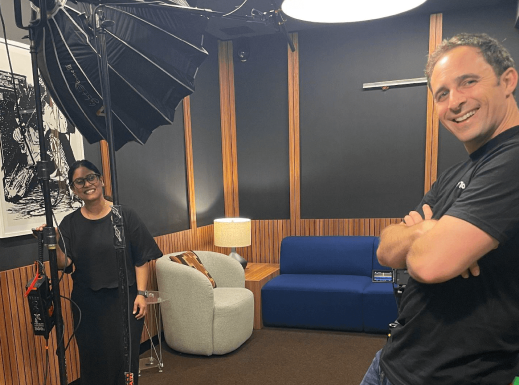
real conversation from behind the camera
This blog is pulled from a recent HowToo mini-podcast conversation between Lisa Vincent (CEO) and Alex Richardson (Head of Partnerships & Growth), recorded straight after a customer video shoot.
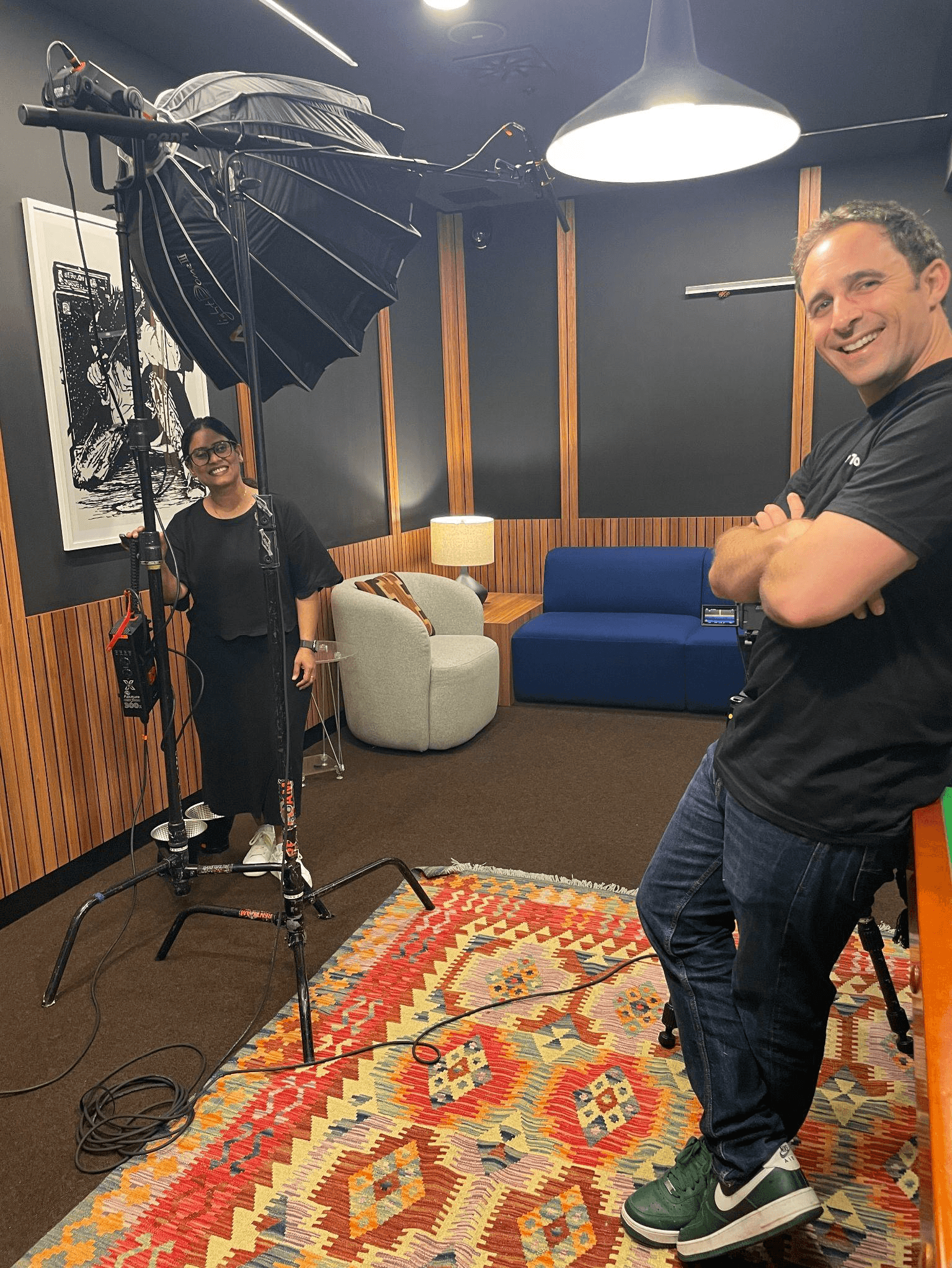
Last month we were back in the studio filming with one of our customers in preparation for the launch of their customer academy. Real people, real cameras, real lights. It took time. It took coordination. It took effort. And by the end of the day, it reminded us why human-led customer and partner education still has such a strong pull.
At the same time, we’re very aware that we don’t live in a purely human world anymore. At HowToo, for customer and partner education, we create some videos with real people and some using AI, all while still needing to reflect the brand learners engage with.
Which is what led us to the question we’re hearing more and more from customers:
Why are we sometimes still doing this the hard way?
For us, we spend a lot of time thinking about how effective customer and partner education scales. Not how it sounds like it should scale, but how it does when teams are under pressure, content needs to stay current, and businesses are growing fast.
That’s where the human vs AI video debate stops being theoretical.
“There is an authenticity that’s hard to fake”
For Lisa, there’s still something essential about having a real person on camera - especially for the moments that define an organisation.
“There is an authenticity from having real people deliver those ‘why’ videos and represent an organization,” she said during the shoot. “You feel it when someone actually believes what they’re saying.”
Straight-to-camera education isn’t just about transferring information. It’s about trust. Tone. Credibility. And right now, humans still do that better, particularly when the content isn’t changing every five minutes.
But authenticity comes with a cost.
Production is heavy. Editing takes time. Maintenance is painful. And if the person fronting the content leaves the business, you’re often left with videos that no longer make sense.And not everyone is made nor comfortable to be in front of a camera.
“At scale, people become the bottleneck”
Alex has lived this problem before, and he doesn’t romanticise it.
“Once you’ve scaled a business, you’ve felt this,” he said. “People become the bottleneck — not because they’re the problem, but because production can’t keep up with the pace.”
This is where AI video starts to look less like a shortcut and more like a necessity.
AI doesn’t need a studio. It doesn’t mind last-minute changes. It doesn’t slow you down when you need to update content across an entire library. And the uncomfortable truth is that the quality is now good enough in many cases.
“AI might not be perfect,” Alex said, “but it’s passable. And if you’re trying to produce hours and hours of content, how else do you realistically do that?”
That question doesn’t have an easy answer.

The real risk isn’t AI - it’s disengagement
Efficiency only matters if learners stay engaged. That’s the line we’re watching closely.
“If the quality isn’t sufficient to keep learners engaged, it’s all for nothing,” Lisa said. “The whole point is connection. And in customer and partner education, that connection is part of how people experience your brand.”
Right now, no one can say with certainty whether AI-generated straight-to-camera education will turn learners off over time. It might not. If it doesn’t, the case for AI becomes overwhelming. If it does, the efficiency gains don’t matter.
This is why we’re cautious about blanket answers.
Three things we’re seeing clearly
From our own work and what customers are telling us, three things are becoming obvious.
- Purely human production doesn’t scale well.
It can be powerful, but it’s slow, expensive, and hard to maintain. - AI video is no longer experimental.
It’s already usable, and in some cases, it’s the only way to keep up. - The future isn’t either/or.
The most effective approach right now is a combination.
The crossover is where it gets interesting
The most exciting space isn’t replacing humans with AI - it’s using humans to teach AI.
“What if you set the benchmark with real people,” Alex said, “and then let AI take on the heavy lifting? Same tone, same presence, same intent - just scalable.”
That’s the hybrid model we’re leaning into. Humans for the content that defines who you are. AI for the content that needs to evolve, scale, and stay current without slowing everything down.
It’s not about cutting corners. It’s about being realistic.
We’re right at the tipping point
We genuinely believe we’re on the edge of a shift. Within the next year, most education content will likely be AI-created in some form. The difference will be whether it feels intentional or accidental, especially for customers and partners engaging with your brand through that content.
At HowToo, we’re not locking ourselves into one camp. We’re experimenting, measuring learner engagement, and continuing to move as the technology (and expectations) evolve.
And yes, for the record, this conversation was filmed by two humans.
For now….

More from
Customer education
category